

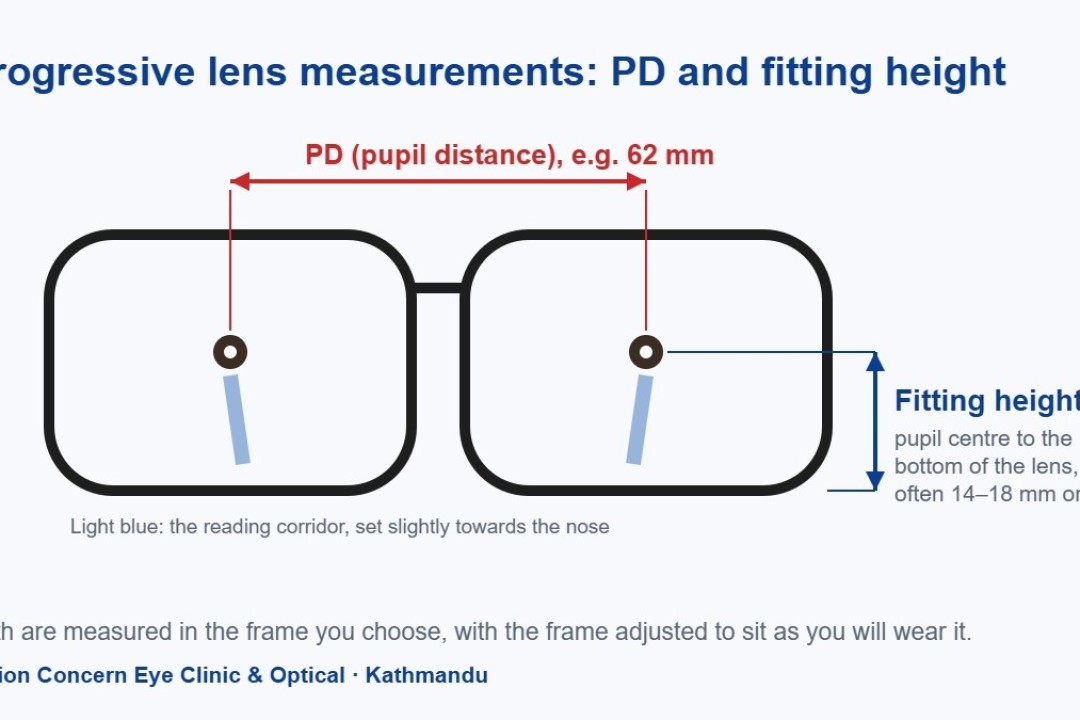
Progressive Lens Fitting Height and PD: How They Are Measured
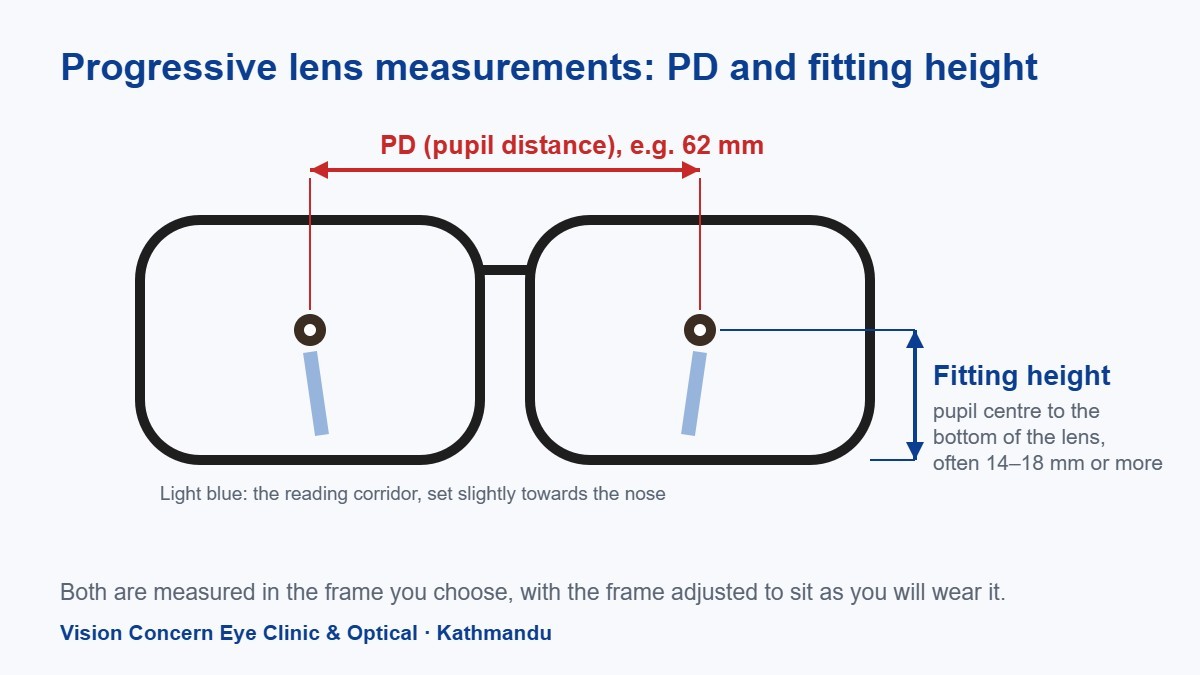
Quick answer: a progressive lens works only if it is placed correctly in front of each eye. Two measurements decide this: the PD (pupil distance), which sets where each lens centre sits sideways, and the fitting height, the vertical distance from the centre of the pupil to the bottom of the lens in your chosen frame. Most progressive designs need a fitting height of roughly 14–18 mm or more. Wrong numbers are the most common reason new progressive glasses feel blurry.
What is PD for progressive lenses?
PD is the distance between the centres of your pupils, usually 54–74 mm in adults. For progressive lenses it is measured separately for each eye (monocular PD, for example 31 / 32 mm) because faces are rarely perfectly symmetrical and the reading corridor must line up with each pupil. A single total PD from an old prescription or an online tool is often not accurate enough for progressives.
What is fitting height?
Fitting height (also called segment height or "seg height") is measured from the centre of the pupil to the lowest point of the lens opening in the frame you have chosen, with the frame adjusted to sit as you will wear it. It decides how much room there is below your eye for the middle (computer) and reading zones.
| Fitting height | What it means |
|---|---|
| Under about 14 mm | Too shallow for most designs; a short-corridor design or a deeper frame is needed. |
| About 14–18 mm | Works with many modern and short-corridor progressive designs. |
| 18 mm and more | Comfortable room for standard designs with wider reading areas. |
The exact minimum depends on the lens design, so we check it against the specific lens before ordering.
Why the frame matters
Because fitting height is measured in the frame, very narrow or fashionable shallow frames can leave too little room for reading. Choose the frame first, have it adjusted (nose pads, temple length, tilt), and only then take the measurements. If the frame later slips down the nose, the reading area moves too – a quick adjustment often fixes "blurry" progressive glasses.
Can I measure PD and fitting height myself?
You can estimate PD at home with a ruler and a mirror, but it is not precise enough for progressive lenses, and fitting height cannot be measured without the actual frame on your face. For progressives, have both measured by an optician or optometrist.
Signs the measurements may be wrong
- You have to tip your head back a lot to read.
- Distance vision is blurry when you look straight ahead.
- One eye is clearer than the other at reading distance.
- Things are not improving after about two weeks of full-time wear.
Read more in why progressive lenses can be blurry and how long it takes to get used to progressive lenses.
How we measure at Vision Concern
At our Kathmandu branches the optometrist or optician checks your prescription, helps you choose a suitable frame, adjusts it, and then measures monocular PD and fitting height in that frame before ordering the lenses. See progressive lens fitting in Kathmandu and current progressive lens prices in Nepal (from NPR 2,000 per pair).
Progressive and bifocal lens prices (per pair) at Vision Concern, Kathmandu
Prices checked and page updated: 24 November 2026. Lens prices are per pair; the final price for your prescription is confirmed after your eye test.
Related pages: Progressive lenses in Kathmandu · Multifocal and bifocal glasses · Varilux and Crizal lenses · Progressive lens adaptation guide
Lazimpat, Boudha-Tushal and Makalbari · open daily 8:00 AM–8:30 PM · book an eye test (NPR 400) · WhatsApp +977 9841466716
Customer story: Raymond's ZEISS PhotoFusion X progressive glasses at Vision Concern Boudha
Raymond, visiting Kathmandu, had his eyes tested and picked up ZEISS PhotoFusion X progressive glasses at our Boudha-Tushal branch, near Boudhanath Stupa. ZEISS progressive lenses give clear vision for distance, computer and reading with no line, and PhotoFusion X lenses darken in the sun and clear indoors.
ZEISS progressive lens prices in Kathmandu · ZEISS optician in Kathmandu · Eye test for tourists (NPR 400) · More visitor video reviews · Watch on YouTube
Yes. Many visitors, particularly from Bangladesh and West Bengal (Kolkata), come to Nepal for cataract, retina, or other eye surgery at a hospital and also want new glasses, a general eye exam, or contact lenses at the same time, before or after their procedure. Vision Concern is an optical and eye-examination clinic, not a surgical hospital, so we work alongside hospitals such as Tilganga: we are happy to see you for glasses, contact lenses, or a routine check-up either side of your surgical treatment elsewhere.
No conversion is needed. Eyeglass prescriptions from Germany, France, the UK, the USA, China, Russia, and almost every other country use the same international format, SPH (sphere), CYL (cylinder), and AXIS, measured in diopters. Our opticians read this directly, so you can bring your prescription paper, a photo of it on your phone, or simply your current glasses, and we will use the same values. If your prescription is more than a year or two old, we recommend a quick, free re-check before we make your new pair.
Yes. Above roughly 3,000 metres, UV exposure increases sharply because of the thinner atmosphere and reflection off snow, and ordinary sunglasses (category 2-3) do not block enough UV to prevent snow blindness (photokeratitis). We recommend glacier glasses or category-4 sunglasses with side shields, and can fit these with your own prescription if needed. Vision Concern offers ZEISS polarized, UV400-certified sunglasses with prescription lenses, which we can prepare before you set off on your trek.