

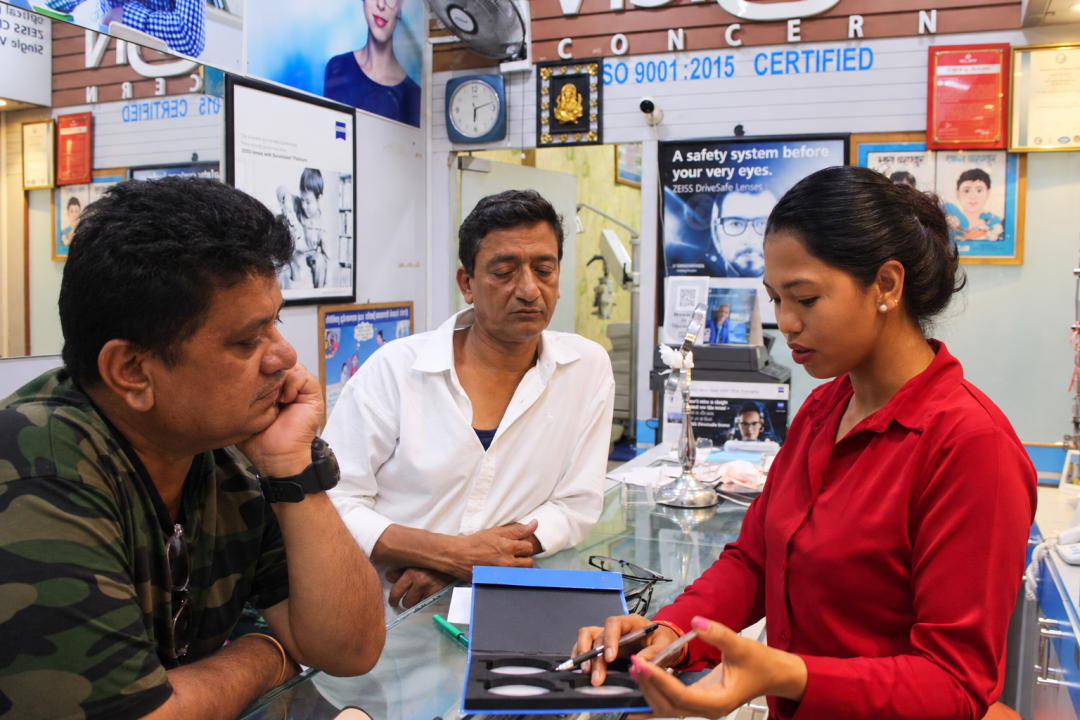
Progressive Lenses in Nepal | Clear Distance, Computer & Reading Vision in One Pair
- Progressive Lenses in Nepal | Clear Distance, Computer & Reading Vision in One Pair
- What Are Progressive Lenses?
- How Progressive Lenses Work
- Who May Benefit from Progressive Glasses?
- Progressive Lens Quality Depends on Fitting as Well as Brand
- Progressive vs Bifocal Lenses
- Progressive Lens Measurements
- Standard vs Premium Progressive Lenses
- ZEISS Progressive Lenses in Nepal
- HOYA Progressive Lenses
- TOKAI Progressive Lenses
- Progressive Lenses for High Power
- Progressive Lenses for Computer Users
- Can Progressive Lenses Be Photochromic?
- Can Progressive Lenses Include Blue-Management Coatings?
- How Long Does Progressive Lens Adaptation Take?
- Why Are My Progressive Lenses Not Clear?
- Progressive Lens Price in Nepal
- Roman Nepali Searches for Progressive Glasses
- Choosing the Right Frame for Progressive Lenses
- Progressive Glasses for Driving
- Progressive Glasses for Tourists & Expats in Kathmandu
- Why Choose Vision Concern for Progressive Lenses?
- Frequently Asked Questions About Progressive Lenses
- 1. What are progressive lenses?
- 2. Do progressive glasses have a visible line?
- 3. Progressive lens kaslai chahincha?
- 4. At what age do people need progressive lenses?
- 5. Can progressive lenses replace reading glasses?
- 6. Are progressive lenses good for computers?
- 7. Are progressive lenses suitable for driving?
- 8. How long does adaptation take?
- 9. Why is there side blur?
- 10. Why is my reading area difficult to find?
- 11. Does fitting height matter?
- 12. Does PD matter?
- 13. Are premium progressive lenses better?
- 14. Are ZEISS progressive lenses available in Nepal?
- 15. Are HOYA progressive lenses available?
- 16. Are TOKAI progressive lenses available?
- 17. Can progressive lenses be high index?
- 18. Can progressive lenses be photochromic?
- 19. How much do progressive lenses cost in Nepal?
- 20. Where can I get progressive glasses in Kathmandu?
- Need Distance, Computer & Reading Vision in One Pair?
- Shop Relevant Products
- Choose progressive glasses with a complete quote
In Kathmandu and worried about your eyes?
Book an eye exam (NPR 400 ≈ US$3) with our English-speaking optometrists in Lazimpat, Boudha or Makalbari — exams by appointment; optical shops open daily 8 AM – 8:30 PM. Card & cash accepted.
Progressive lenses allow suitable wearers to see across multiple distances using one pair of glasses. The upper portion is generally used for distance, the middle portion for intermediate tasks such as computers, and the lower area for reading and other close work.
Unlike traditional bifocals, progressive lenses provide a gradual change in power without a visible dividing line. They are commonly considered by adults who need different prescriptions for far and near vision.
Ask About Progressive LensesReplies within minutes
What Are Progressive Lenses?
Progressive lenses are no-line multifocal spectacle lenses containing a gradual change in prescription power. They are designed to provide useful vision for distance, intermediate and near tasks within a single pair of glasses.
They are often selected by adults with presbyopia who would otherwise need separate distance, computer and reading glasses.
How Progressive Lenses Work
| Lens Area | Typical Use |
|---|---|
| Upper Zone | Distance vision, road signs, television and outdoor viewing. |
| Middle Zone | Computer screens, dashboards and intermediate-distance tasks. |
| Lower Zone | Reading, mobile phones and close work. |
Who May Benefit from Progressive Glasses?
- Adults who need separate distance and reading correction
- People who constantly switch between multiple pairs of glasses
- Office professionals using computers and mobile phones
- Drivers who also need clear dashboard vision
- People who prefer glasses without a visible bifocal line
- Existing bifocal wearers considering a no-line multifocal option
Progressive Lens Quality Depends on Fitting as Well as Brand
Buying an expensive progressive lens does not automatically guarantee comfortable vision. Accurate prescription, appropriate lens design, monocular pupil distance, fitting height and correct frame adjustment are all important.
The frame should ideally be selected and adjusted before final progressive measurements are taken.
Progressive vs Bifocal Lenses
| Feature | Progressive | Bifocal |
|---|---|---|
| Distance Vision | Yes | Yes |
| Near Vision | Yes | Yes |
| Intermediate Vision | Included in progressive corridor | Limited in traditional bifocal designs |
| Visible Line | No | Usually yes |
| Adaptation | May require adjustment period | Different adaptation pattern |
Progressive Lens Measurements
Professional fitting commonly considers several measurements and frame-related factors.
- Monocular PD: horizontal position of each pupil.
- Fitting height: vertical positioning of the progressive design.
- Frame dimensions: influence available lens space and design.
- Frame position: affects how the wearer looks through different viewing areas.
- Prescription: sphere, cylinder, axis and near addition must be accurate.
| Feature | Standard Progressive | Premium / Personalised Progressive |
|---|---|---|
| Design | General progressive design | May incorporate additional wearer or frame parameters |
| Viewing Zones | Standard usable areas | May offer wider or more optimised useful zones |
| Best Considered For | General everyday requirements | Demanding visual tasks or premium personalisation |
ZEISS Progressive Lenses in Nepal
Vision Concern provides selected ZEISS progressive-lens options for customers seeking premium multifocal designs. Available designs vary according to prescription, frame and individual visual requirements.
ZEISS Progressive Lenses in KathmanduHOYA Progressive Lenses
Selected HOYA progressive lenses may be considered according to prescription, daily visual demands, frame choice and availability.
TOKAI Progressive Lenses
Selected TOKAI progressive products provide additional options for customers interested in Japanese lens technology, including high-index solutions for suitable stronger prescriptions.
Progressive Lenses for High Power
Customers with stronger prescriptions may combine a progressive design with a suitable high-index lens material. Lens thickness depends not only on index but also on prescription, frame size, shape and centration.
High-Index Ultra-Thin Prescription LensesProgressive Lenses for Computer Users
People who use computers throughout the day should explain their normal screen distance and working setup. A general progressive lens may work well for many users, while some intensive computer users may prefer an office or occupational lens with larger intermediate and near areas.
Computer & Blue Light GlassesCan Progressive Lenses Be Photochromic?
Selected progressive lens designs can be combined with compatible photochromic technology, allowing the lenses to become darker outdoors and clearer indoors depending on the product.
Can Progressive Lenses Include Blue-Management Coatings?
Selected progressive products may be combined with compatible anti-reflective, blue-management or premium coating options according to manufacturer and prescription availability.
How Long Does Progressive Lens Adaptation Take?
Some people become comfortable within several days, while others require longer. First-time progressive wearers need to learn how to use different areas of the lens for different viewing distances.
Persistent significant blur, dizziness or difficulty finding the correct zones should be professionally reviewed rather than simply tolerated indefinitely.
How Long Does It Take to Adjust to Progressive Glasses?Why Are My Progressive Lenses Not Clear?
Possible reasons include prescription changes, inaccurate measurements, frame misalignment, unsuitable progressive design, incorrect fitting height or adaptation difficulties.
Why Are My Progressive Lenses Not Clear?Progressive Lens Price in Nepal
Progressive lens prices vary considerably depending on brand, design, prescription, index, coating and level of personalisation.
Instead of comparing only the lowest price, compare the actual lens design, measurement quality, material, coating and suitability for your daily tasks.
Check Progressive & Optical Lens PricesRoman Nepali Searches for Progressive Glasses
Choosing the Right Frame for Progressive Lenses
Frame selection is important because progressive lenses need sufficient vertical space for the distance, intermediate and reading areas.
The frame should fit securely without constantly sliding down or sitting crooked, because changes in frame position can alter where the wearer looks through the progressive zones.
Progressive Glasses for Driving
Many adapted progressive wearers use their glasses for driving because the upper lens provides distance vision while the intermediate zone can assist with dashboard viewing.
New wearers should become comfortable with the lenses before relying on them for demanding driving situations.
Progressive Glasses for Tourists & Expats in Kathmandu
Vision Concern assists tourists, expatriates and international visitors who need progressive glasses in Nepal. Custom progressive lenses can require production time, so travellers should send their prescription and departure date before ordering.
Eye Care for Tourists & ExpatsWhy Choose Vision Concern for Progressive Lenses?
Distance and near requirements evaluated.
Monocular PD and fitting height considered.
Selected ZEISS, HOYA and TOKAI progressive lenses.
Thin-lens materials for suitable stronger prescriptions.
Frame size and position considered before ordering.
Lazimpat | Boudha-Tushal | Makalbari.
Frequently Asked Questions About Progressive Lenses
1. What are progressive lenses?
Progressive lenses provide distance, intermediate and near vision through gradually changing powers in one lens.
2. Do progressive glasses have a visible line?
No. Progressive lenses provide a no-line transition between different viewing powers.
3. Progressive lens kaslai chahincha?
They are commonly considered by people who require different prescriptions for distance and near vision.
4. At what age do people need progressive lenses?
There is no fixed age. They are commonly considered when presbyopia begins affecting near vision.
5. Can progressive lenses replace reading glasses?
For many suitable wearers, one progressive pair can provide both distance and reading correction.
6. Are progressive lenses good for computers?
They can be useful for many computer users because they include an intermediate zone.
7. Are progressive lenses suitable for driving?
Many adapted wearers use progressives for driving and dashboard viewing.
8. How long does adaptation take?
Some people adapt within several days while others may require one to two weeks or longer.
9. Why is there side blur?
Progressive designs contain changing powers and peripheral areas that may feel different from single-vision lenses.
10. Why is my reading area difficult to find?
Possible reasons include adaptation, fitting height, frame position, ADD power or lens design.
11. Does fitting height matter?
Yes. Accurate fitting height helps position the progressive corridor correctly relative to the pupil.
12. Does PD matter?
Yes. Correct horizontal positioning helps align the progressive design with each eye.
Premium designs may provide additional personalisation or wider usable zones, but suitability depends on the individual wearer.
14. Are ZEISS progressive lenses available in Nepal?
Vision Concern provides selected ZEISS progressive-lens options subject to prescription and availability.
15. Are HOYA progressive lenses available?
Selected HOYA progressive options may be available according to prescription and product availability.
16. Are TOKAI progressive lenses available?
Selected TOKAI progressive and high-index options may be available.
17. Can progressive lenses be high index?
Yes. Selected progressive designs can be produced using high-index materials for suitable prescriptions.
18. Can progressive lenses be photochromic?
Selected progressive lenses may be combined with compatible photochromic technology.
19. How much do progressive lenses cost in Nepal?
Price depends on brand, lens design, index, coating, prescription and degree of personalisation.
20. Where can I get progressive glasses in Kathmandu?
Vision Concern provides progressive-lens consultation at Lazimpat, Boudha-Tushal and Makalbari.
Need Distance, Computer & Reading Vision in One Pair?
Send your prescription and tell Vision Concern how you use your eyes throughout the day.
WhatsApp +9779841466716Replies within minutes
Lazimpat: 01-4543117 | Boudha-Tushal: 01-4562303 | Makalbari: 01-5134042
Shop Relevant Products
Ready to compare suitable options? View the related Vision Concern products below. Prescription and contact-lens suitability should be confirmed professionally.
In Kathmandu and worried about your eyes?
Book an eye exam (NPR 400 ≈ US$3) with our English-speaking optometrists in Lazimpat, Boudha or Makalbari — exams by appointment; optical shops open daily 8 AM – 8:30 PM. Card & cash accepted.
Choose progressive glasses with a complete quote
Bring your prescription and discuss your reading, screen and distance needs. Ask for an itemised quote covering the frame, lens design, brand, coating and fitting, plus the expected collection date, before placing your order.
Visiting Nepal or comparing with a quote in your home country? Send the same product specification and quantity. Compare the complete Nepal quote in NPR, including fitting and any applicable delivery, currency-conversion or customs costs. Confirm availability and timing against your travel dates before paying.
Book a progressive-glasses consultation Ask for a complete price on WhatsApp
Replies within minutes Explore progressive glasses
Replies within minutes
Yes. Many visitors, particularly from Bangladesh and West Bengal (Kolkata), come to Nepal for cataract, retina, or other eye surgery at a hospital and also want new glasses, a general eye exam, or contact lenses at the same time, before or after their procedure. Vision Concern is an optical and eye-examination clinic, not a surgical hospital, so we work alongside hospitals such as Tilganga: we are happy to see you for glasses, contact lenses, or a routine check-up either side of your surgical treatment elsewhere.
No conversion is needed. Eyeglass prescriptions from Germany, France, the UK, the USA, China, Russia, and almost every other country use the same international format, SPH (sphere), CYL (cylinder), and AXIS, measured in diopters. Our opticians read this directly, so you can bring your prescription paper, a photo of it on your phone, or simply your current glasses, and we will use the same values. If your prescription is more than a year or two old, we recommend a quick, free re-check before we make your new pair.
Yes. Above roughly 3,000 metres, UV exposure increases sharply because of the thinner atmosphere and reflection off snow, and ordinary sunglasses (category 2-3) do not block enough UV to prevent snow blindness (photokeratitis). We recommend glacier glasses or category-4 sunglasses with side shields, and can fit these with your own prescription if needed. Vision Concern offers ZEISS polarized, UV400-certified sunglasses with prescription lenses, which we can prepare before you set off on your trek.